The Holy Patriarchs of Constantinople of the First Millennium
Introduction
 |
| Icon of the Patriarchs of Constantinople (https://www.johnsanidopoulos.com/2014/05/synaxis-of-all-our-holy-fathers.html) |
In creating this list I aim to show the veneration of the bishops of Constantinople that existed before the Great Schism of Eastern Orthodoxy and Roman Catholicism.
In creating this list I have chosen to solely use Eastern Church Calendars. Many of the Patriarchs of Constantinople figure in Western Calendars, but I have decided to focus solely on Eastern Calendars for the sake of space. Since the Church was one church with different rites, the saints in the Eastern Calendar are saints of the West, even if not commemorated on Western Calendars. The same is true with saints on the Western Calendar but not on the Eastern. With this in mind we must examine the Calendars consulted.
Calendars
The Typicon of the Great Church = Juan Mateos, ed. and tr., Le Typicon de la Grande Église, Volume 1 (Rome: 1962). The Typicon shows the church calendar used in the Hagia Sophia at the middle of the tenth century. It relies on two manuscripts:
Codex H (Holy Cross Monastery Codex 40) is dated by Mateos to the years 950-970, with 950-959 being the more probable. Venance Grumel however dates the ms. to the end of the tenth century, and believes it to be an edited copy of an earlier work. [Venance Grumel, 'Le Typicon de la Grande Église d'apres le Manuscrit de Sainte-Croix: Datation et Origine', Analecta Bollandia, 85 (1967), 45-57] Regardless the ms. certainly seems to be from the tenth century. This manuscript covers the entire year, with only a few days at the end of August absent.
Codex P (Patmos Codex 266) is dated from the second half of the ninth century to the first half of the tenth. This manuscript covers the entire year.
The Synaxarium of Constantinople = Hippolyte Delehaye, ed., Synaxarium Ecclesiae Constantinopolitanae (Brussels: Bollandist Society, 1902). The Synaxarium was commissioned during the reign of Emperor Constantine VII (944-959). There are several manuscripts that are used in Delehaye's edition, the most important early ones are the following:
Codex F (Codex Saint Mark 267) is dated to 1050. This manuscript covers September to February.
Codex Fa (National Library in Paris Codex 1590) is dated to 1063. This manuscript covers September to February.
Codex N (National Library in Paris Codex 1617) is dated to 1071. This manuscript covers March to August.
The Menologion of Basil II = Jacques Paul Migne, ed., Patrologia Graeca, Volume 117 (Paris: 1864). The Menologion was compiled for Emperor Basil II (976-1025) and so dates to anytime during his reign, although it most likely was made ca. 1000. The Menologion covers the entire year.
The Calendar of John Zosimus = Gérard Garitte, ed. and tr., Le Calendrier du Palestino-Géorgien du Sinaiticus 34 (Xe Siecle) (Brussels: Bollandist Society, 1958). John Zosimus was a Georgian monk and scribe who lived in Palestine in the tenth century, dying sometime around 990. He wrote a church calendar which survives in an autographed copy in Mount Sinai written in Georgian. The Calendar covers the entire year.
I have managed to find another manuscript for an ancient Synaxarion. The Manuscript is Saint Catherine's Monastery in Sinai, Greek Manuscript 548 (St. Catherine Ms. Gr. 548), and is sometimes called Codex Hs. The Manuscript dates to the 10th-11th centuries. [Kenneth W. Clark, ed., Checklist of Manuscripts in St. Catherine's Monastery, Mount Sinai (Washington, D.C.: Library of Congress, 1952), p. 8; Jacques Noret, 'Un Nouveau Manuscrit Important Pour L'Histoire Du Synaxaire', Analecta Bollandiana, 87.1-2 (1969), p. 90, writes 'La datation en fin du xe s. ne serait pas absurde à notre avis.'] It is significant in that it contains notices for Photius, Nicholas I, Stephen II, and Tryphon [Noret, 'Un Nouveau Manuscrit', p. 90].
List of Patriarchs
Metrophanes (306-314)
Le Typicon, p. 305 (Jun. 4) [Codices P & H]; Synaxarium, cols. 727.17-730.5 [Codex N]; Le Calendrier, p. 70 (Jun. 4); Menologion, col. 488A
Alexander I (314-337)
Le Typicon, p. 109 (Nov. 20) [Codex P Only]; Synaxarium, cols. 239.56-59 (Nov. 20) [Codices F & Fa]; Le Calendrier, p. 87 (Aug. 30).
Paul I (337-350)
Le Typicon, p. 91 (Nov. 6) [Codices P & H]; Synaxarium, cols. 197.5-198.6 (Nov. 6th) [F & Fa]; Menologion, col. 145C (Nov. 6); Le Calendrier, p. 102 (Nov. 5).
Gregory I (380-381)
Le Typicon, p. 211 (Jan. 25) [Codices P & H]; Synaxarium, 421.11-423.11 (Jan. 25) [Codices F & Fa]; Le Calendrier, pp. 46 (Jan. 25) & 85 (Aug. 23); Menologion, col. 280B (Jan. 25)
Nectarius (381-397)
Le Typicon, p. 67 (Oct. 11) [Codices P & H]; Synaxarium, col. 131.21-24 [Codices F & Fa]
John I (397-404)
Le Typicon, pp. 99-101 (Nov. 13 - His Exile) [Codices P & H] & 213-215 (Jan. 27 - Translation of Relics) [Codices P & H]; Synaxarium, cols. 46.8-16 (Sep. 14) [Codices F & Fa] & 217.37-220.4 (Nov. 13) [Codices F & Fa]; Menologion, cols. 157B (Nov. 13 - His Exile) & 281D (Jan 27 - Translation of Relics); Le Calendrier, pp. 46-47 (Jan. 26-27 & 29), 85 (Aug. 23), 90 (Sep. 15), & 103 (Nov. 13)
 |
| Patriarch John I "Chrysostom" (https://commons.wikimedia.org/wiki/File:Semen_Spiridonov_Kholmogorets._John_Chrysostom._1670-1680th.jpg) |
Arsacius (404-405)
Le Typicon, p. 67 (Oct. 11) [Codices P & H].
Atticus (406-425)
Le Typicon, p. 67 (Oct. 11) [Codices P & H]; Synaxarium, col. 131.21-24 (Oct. 11) [Codices F & Fa]
Sisinnios (425-426)
Le Typicon, p. 67 (Oct. 11) [Codices P & H]; Synaxarium, col. 131.21-24 (Oct. 11) [Codices F & Fa]
Maximianus (431-434)
Le Typicon, p. 269 (Apr. 21) [Codices P & H]; Synaxarium, col. 240.27-30 (Oct. 11) [Codices F & Fa]; Le Calendrier, p. 61 (Apr. 20); Menologion, col. 416D
Proclus (434-446)
Le Typicon, p. 77 (Nov. 20) [Codices P & H]; Synaxarium, col. 240.27-30 (Nov. 20) [Codices F & Fa]; Menologion, col. 125B (Oct. 24); Le Calendrier, p. 105 (Nov. 19 & 20).
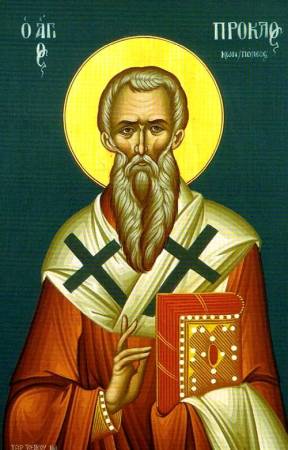 |
| Patriarch Proclus (https://commons.wikimedia.org/wiki/File:Proclus_of_constantinople.jpg) |
Flavian (446-449)
Le Typicon, pp. 99 (Nov. 12) [Codices P & H] & 235 (Feb. 17) [Codex H Only]; Menologion, col. 320B (Feb. 17).
Anatolius (451-458)
Le Typicon, pp. 109 (Nov. 20th) [Codices P & H] & 331 (Jul. 3rd) [Codices P & H]; Synaxarium, col. 240.27-30 (Nov. 20th) [Codices F & Fa]; Le Calendrier, p. 77 (Jul. 9th); Menologion, col. 520D (Jul. 3rd)
Gennadius I (458-471)
Le Typicon, pp. 109 (Nov. 20) [Codices P & H] & 383 (Aug. 25) [Codices P & H]; Synaxarium, col. 240.27-30 (Nov. 20) [Codices F & Fa]; Menologion, col. 605B (Aug. 25)
Macedonius II (495-511)
Le Typicon, p. 275 (Apr. 25) [Codices P & H].
John II (518-520)
Le Typicon, p. 383 (Aug. 25) [Codices P & H]; Menologion, col. 605B (Aug. 25)
Epiphanius (520-535)
Le Typicon, p. 383 (Aug. 25) [Codices P & H]
Menas (536-552)
Le Typicon, p. 383 (Aug. 24) [Codex P Only] (Aug. 25) [Codices P & H]; Menologion, cols. 604B (Aug. 24) & 605B (Aug. 25).
Eutychius (552-565 & 577-582)
Le Typicon, p. 263 (Apr. 6) [Codices P & H]; Le Calendrier, p. 58 (Apr. 6); Menologion, col. 388C (Apr. 6); Le Calendrier, p. 58 (Apr. 6)
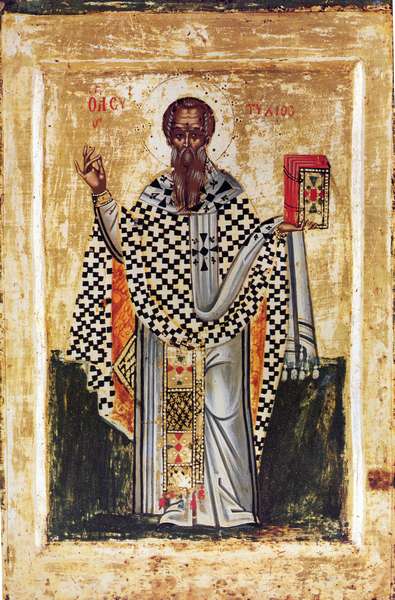 |
| Patriarch Eutychius (https://commons.wikimedia.org/wiki/File:Eutychius_of_Constantinople.jpg) |
John III (565-577)
Le Typicon, p. 387 (Aug. 30) [Codex P Only].
The date in the Typicon and on August 30th aligns with the date of death of John as recorded by Theophanes the Chronographer (Cyril Mango and Roger Scott, trs., The Chronicle of Theophanes Confessor (Oxford: Clarendon Press, 1997), p. 368).
John IV "The Faster" (582-595)
Le Typicon, pp. 13 (Sep. 2) [Codices P & H] & 235 (Feb. 18) [Codices P & H]; Synaxarium, cols. 7.16─8.13 (Sep. 2) [Codices F & Fa]; Menologion, col. 25A (Sep. 2).
Cyriacus II (595-606)
Le Typicon, p. 83 (Oct. 30) [Codices P & H]; Synaxarium, col. 178.18-20 (Oct. 30) [Codices F & Fa].
Thomas I (607-610)
Le Typicon, pp. 235 (Feb. 18) [Codices P & H], (Feb. 22) [Codices H & P], (Mar. 22) [Codices H & P]
Thomas II (667-669)
Le Typicon, p. 101 (Nov. 14) [Codices P & H]; Synaxarium, col. 223.41-42 (Nov. 14) [Codex F Only]
Patriarch Thomas II is venerated on November 14th, a date that corresponds with his repose on November 15th [Jan Louis Van Dieten, Geschichte Der Patriarchen Von Sergios I. Bis Johannes VI (610-715) (Amsterdam: Verlag Adolf M. Hakkert, 1972), p. 120].
John V (669-675)
Le Typicon, p. 377 (Aug. 18) [Codices P & H]; Synaxarium, col. 908.38-41 (Aug. 18) [Codex N]
Constantine I (675-677)
Le Typicon, p. 367 (Aug. 9) [Codices P & H].
Theodore I (677-679)
Le Typicon, p. 165 (Dec. 28) [Codices P & H]; Synaxarium, col. 351.17-56 (Dec. 28) [Codices F & Fa]; Menologion, col. 229C; Le Calendrier, p. 112 (Dec. 28).
George I (679-686)
Le Typicon, pp. 377 (Aug. 18) [Codices P & H] & 379 (Aug. 20) [Codex P Only].
Paul III (687-693)
Le Typicon, p. 379 (Aug. 20) [Codices P & H]
Callinicus (693-705)
Le Typicon, p. 383 (Aug. 23) [Codices P & H]; Menologion, col. 600C (Aug. 23).
Cyrus (705-711)
Le Typicon, p. 197 (Jan. 7) [Codex H Only]; Synaxarium, col. 376.26-31 (Jan. 7) [Codices F & Fa]
Germanus (715-730)
Le Typicon, p. 291 (May 12) [Codices P & H]; Menologion, col. 452C (May 12th)
 |
| Patriarch Germanus (https://commons.wikimedia.org/wiki/File:Patriarch_Germanus_I_of_Constantinople.jpg) |
Paul IV (780-784)
Le Typicon, p. 387 (Aug. 31) [Codex P (Codex H lacks the date of August 31)]
Tarasios (784-806)
Le Typicon, p. 241 (Feb. 25) [Codices P & H]; Menologion, col. 328B (Feb. 25); Le Calendrier, p. 52 (Feb. 25).
Nicephorus (806-815)
Le Typicon, pp. 249 (Mar. 13 - Translation of Relics) [Codices P & H] & 303 (Jun. 2 - Feast Day) [Codices P & H]; Menologion, col. 484D (Jun. 2); Le Calendrier, p. 70 (Jun. 2).
Methodius (843-847)
Le Typicon, p. 315 (Jun. 14) [Codices P & H]; Le Calendrier, p. 72 (Jun. 14)
Ignatius (847-858 & 867-877)
Le Typicon, p. 77 (Oct. 23) [Codices P & H]; Synaxarium, cols. 158.13-160.12 [Codices F & Fa]; Menologion, col. 124C (Oct. 23)
Photius (858-867 & 877-886)
Le Typicon, p. 229 (Feb. 6) [Codex H Only]; St. Catherine Ms. Gr. 548.
 |
| Patriarch Photius "The Great" (https://commons.wikimedia.org/wiki/File:Riza.jpg) |
Stephen I (886-893)
Le Typicon, p. 301 (May 27) [Codex H Only]
Anthony II (893-901)
Le Typicon, p. 231 (Feb. 12) [Codex H Only]; Synaxarium, cols. 460.40-462.23 (Feb. 12) [Codices F & Fa]
Nicholas I (901-907 & 912-925)
Le Typicon, pp. 293-295 (May 15) [Codex H Only]; St. Catherine Ms. Gr. 548.
Stephen II (925-928)
Le Typicon, p. 345 (Jul. 18) [Codex H Only]; St. Catherine Ms. Gr. 548.
Tryphon (928-931)
Le Typicon, p. 269 (Apr. 18) [Codex H Only]; St. Catherine Ms. Gr. 548.
Disputed
Acacius (472-489)
On the 11th of October, for Codices P & H for the Typicon, we read that Arsacius is to be venerated, but Codices F & Fa for the Synaxarium replace Arsacius with Acacius of Constantinople, the prelate for whom the Acacian schism is named after. Either Acacius was venerated in Constantinople prior to the schism, or a simple mistake replaced Arsacius for Acacius.
Anastasius (730-754)
Several of the later manuscripts write that Patriarch Anastasius of Constantinople was to be commemorated on February 10th. This is quite strange given that Anastasius was an iconoclast (despite a period in which he recanted from iconoclasm only to return to it). Instead, it is likely that the Anastasius to be venerated is Anastasius II, the Patriarch of Jerusalem. Codex P writes of ‘Anastasius, Bishop of Jerusalem,’ but I cannot determine whether this is Anastasius I or II. It seems more likely to be the latter because of the conflation with Anastasius the Patriarch of Constantinople; Anastasius II of Jerusalem had to reign in Constantinople because of the Arab invasion and participated at the Quinisext Council of 691, hence his confusion with the Iconoclast Patriarch.
This argument comes from John Sanidopoulos (https://www.johnsanidopoulos.com/2011/02/anastasios-of-constantinople-iconoclast.html) who himself cites it from Holy Apostles Convent's The Great Synaxarion of the Orthodox Church.
Constantine II (754-766)
In Codex P in the Typicon for July 30th we find a commemoration for a "John, Archbishop of Constantinople." In Codex H for the same day, however, we find a commemoration for a "Constantine the New, Archbishop of Constantinople." [Le Typicon, pp. 353-355] Going by the dates of composition for H, the Constantine that appears to venerated is Constantine II (754-766) but this is surprising giving that Constantine II was an iconoclast who supported the destruction of images!
This raises the following two questions: First, is Constantine II truly being venerated here or is it a mistake for someone else, such as John found in Codex P; and secondly, if Constantine II is the one venerated here, then for what reason was he placed in the calendar? The only reason I can think of Constantine II's veneration is the details of the end of his life. He fell foul of the Emperor who exiled him, then he was called back to Constantinople, only for the Emperor to give Constantine a public humiliation. Constantine was beaten in front of a large crowd in the Hippodrome before being beheaded. Did some cult of Constantine develop in response to this brutal end of his life?
The cases of Anastasius and Constantine are interesting since both were condemned as heretics by the 7th Ecumenical council. "To Anastasius [&] Constantine [...] who in succession presided over the see of Constantinople, as to a new Arius [&] Nestorius [...] anathema!" [Richard Price, tr., The Acts of the Second Council of Nicaea (787) (Liverpool: Liverpool University Press, 2020), p. 577]


